Ford's Online Ordering
A transparent, self-directed online vehicle ordering experience
VML + Ford Motor Co.
The Ask
Design a radically transparent, customer-empowering vehicle ordering experience amid global supply chain disruption.
My Role
Sr. User Experience Designer
Journey Mapping, Touchpoint Mapping, Wireframing, Prototyping, Stakeholder Alignment
Results
Delivered a validated, fully tested end-to-end ordering journey to Ford leadership • Synthesized recommendation grounded in multiple rounds of user testing
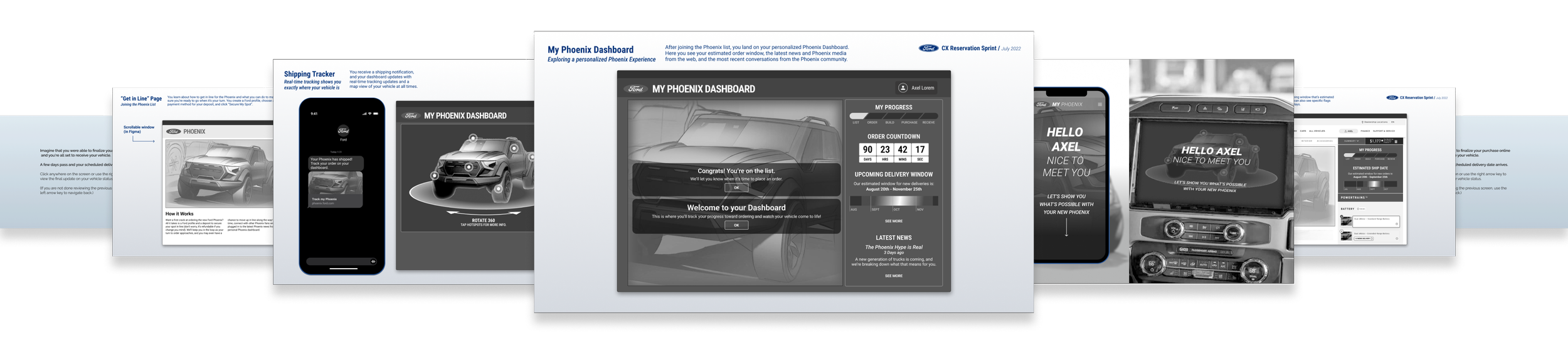
Several screens from the final prototype used in several rounds of user testing.
Background
Amid global supply chain disruptions, ordering a custom vehicle had become an opaque, frustrating experience. Customers who reserved or pre-ordered a Ford vehicle were often waiting months or more with no meaningful communication and no clear understanding of their order status or estimated delivery. Ford's leadership wanted to meet this world of unknowns with a radically transparent and empowering customer experience, and asked a small team of experience designers and strategists to design, test, and prototype an online vehicle ordering experience that put customers in the driver's seat.
Team & Role
I was a Senior User Experience Designer on a small team of 2 to 4 designers and design leads, supported by project managers and client engagement teammates. I joined after the team had already completed the Reframe, Investigate and Synthesize phases of the consumer journey work, and key themes and opportunity areas were identified.
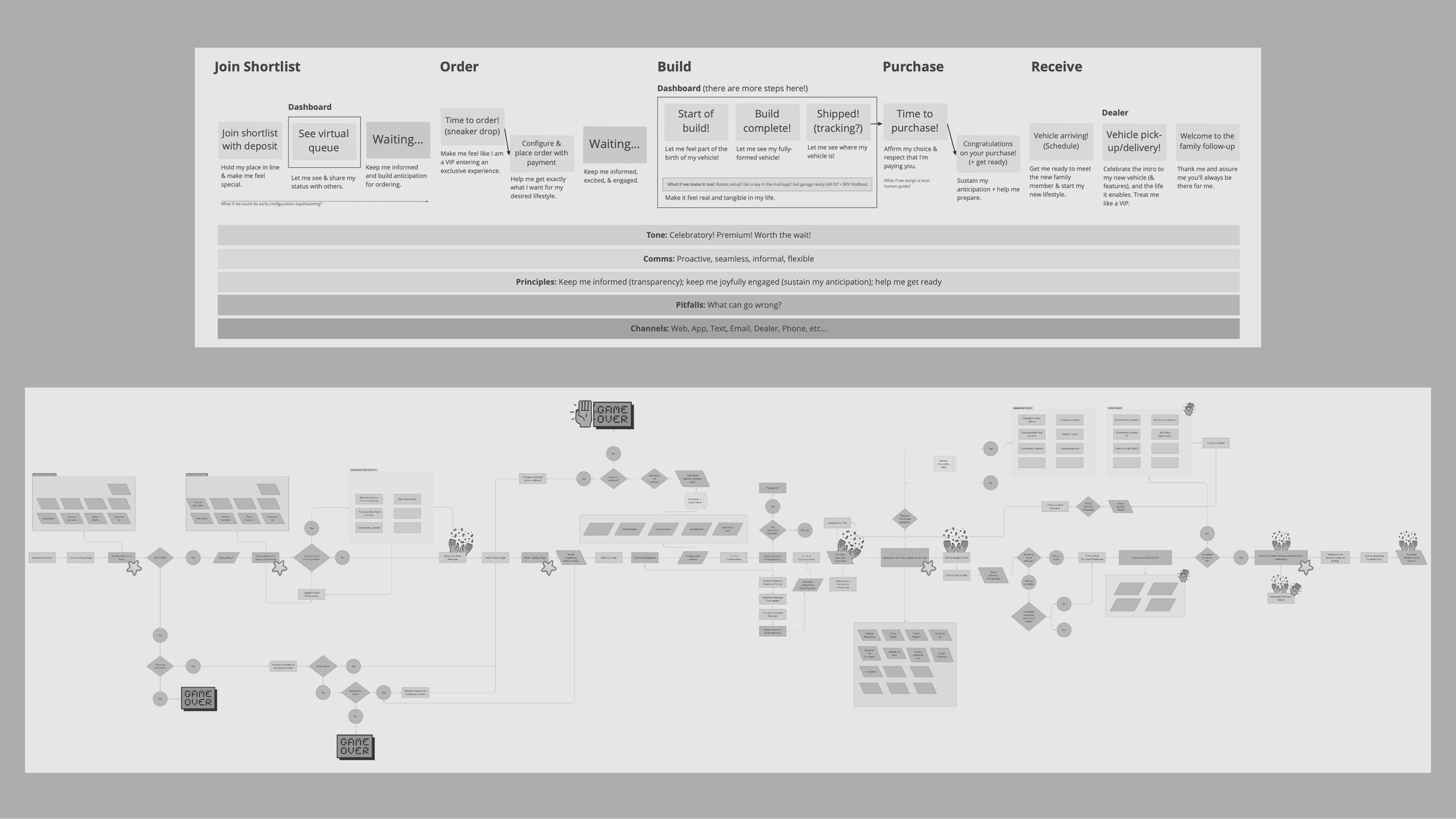
I joined the team as we wrapped up the details of the touchpoint mapping, behavioral mapping and pain point identification documents.
Approach
I picked up the project in the Explore phase, closing out remaining future-state experience mapping, touch-point mapping, and pain point identification. I started with building screen flow diagrams to visualize the emerging journey. From there, I helped craft the full end-to-end journey spanning five stages (Join shortlist, Order, Build, Purchase, and Receive) from the moment a vehicle became available for reservation to the moment a customer picked it up at the dealership.
Key moments in the experience centered on giving customers real trade-off decisions:
Fastest available configuration vs. fully custom build
Full transparency into the procurement process
Ability to make changes at any point
Consistent communication and control in the customer's hands from start to finish.
I translated this journey into mid-fidelity wireframes, low-fidelity prototypes, and micro-interactions, iterating through multiple rounds of team critique and stakeholder alignment. The wireframes were then built out into a narrative prototype and put through several rounds of user testing and refinement, with results synthesized into a final set of deliverables presented to Ford's leadership team.
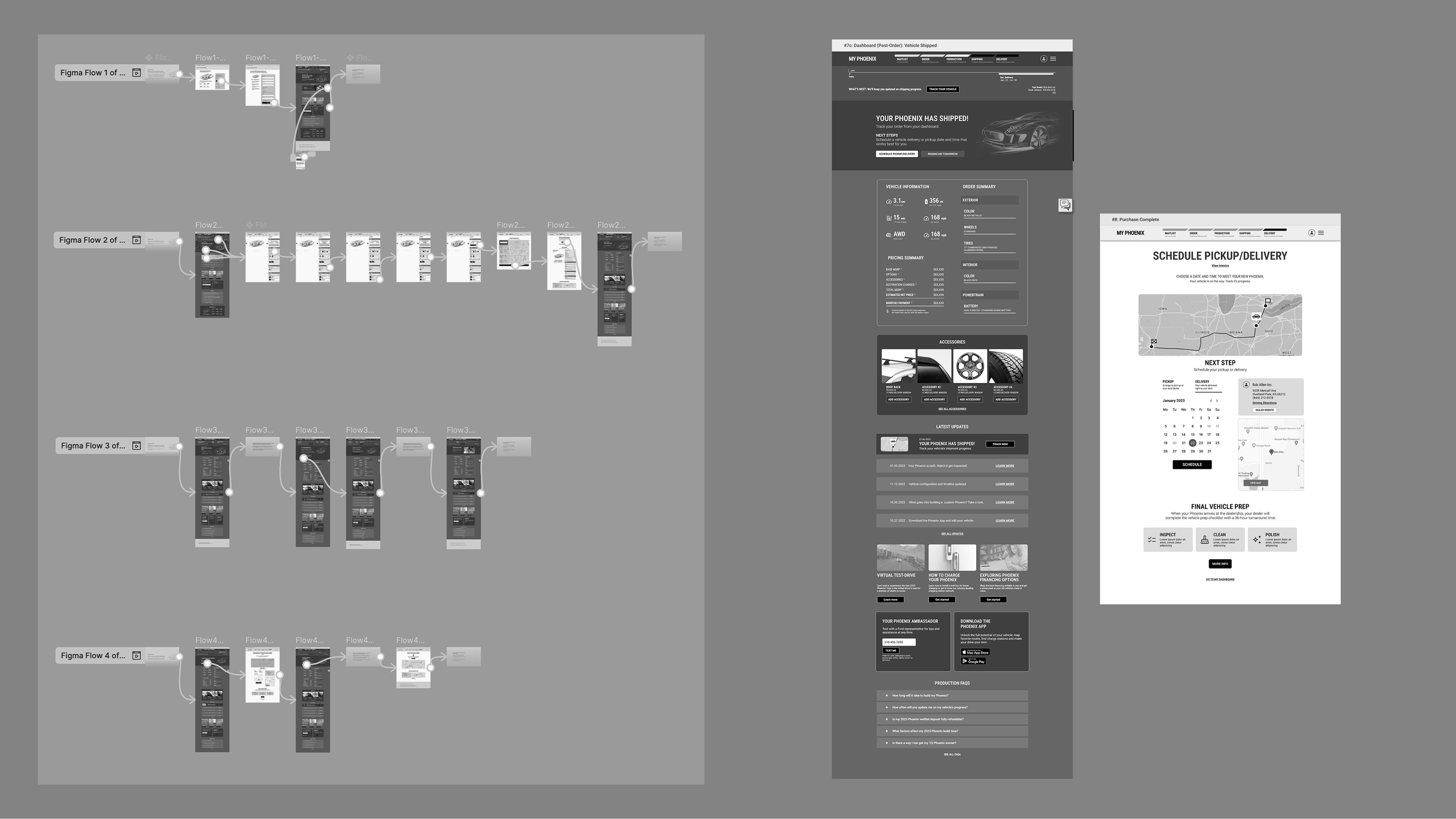
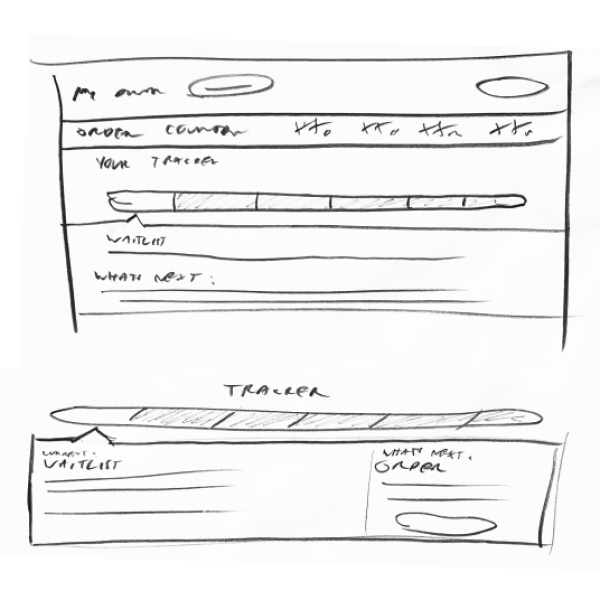
Left: Using Figma to create and test a simple prototype for user testing. Right: Detailed full page designs for the Dashboard in various states of the Production and Delivery phases.
Challenges
One core challenge was visualizing a complicated, multi-stage timeline in a way customers could quickly understand where they stood and what was coming next, while preserving full transparency and the ability to make changes throughout. A second challenge was calibrating the right balance of customization freedom against real-world constraints: the existing dealership model, and the role of individual dealers in final delivery and accessories, significantly shaped what was actually possible to build into the journey.
A third challenge was orchestrating the experience across channels while the primary interaction lived on a desktop micro-site. Text messaging and mobile communication were prioritized for key touch-points, requiring the desktop and mobile experiences to work in lockstep to avoid decision bottlenecks and delays.
The Outcome
The final journey, wireframes, and tested prototype were delivered to Ford's leadership team as a synthesized recommendation grounded in multiple rounds of user testing and refinement, giving Ford a validated, customer-centered vision for what a transparent, self-directed ordering experience could look like.
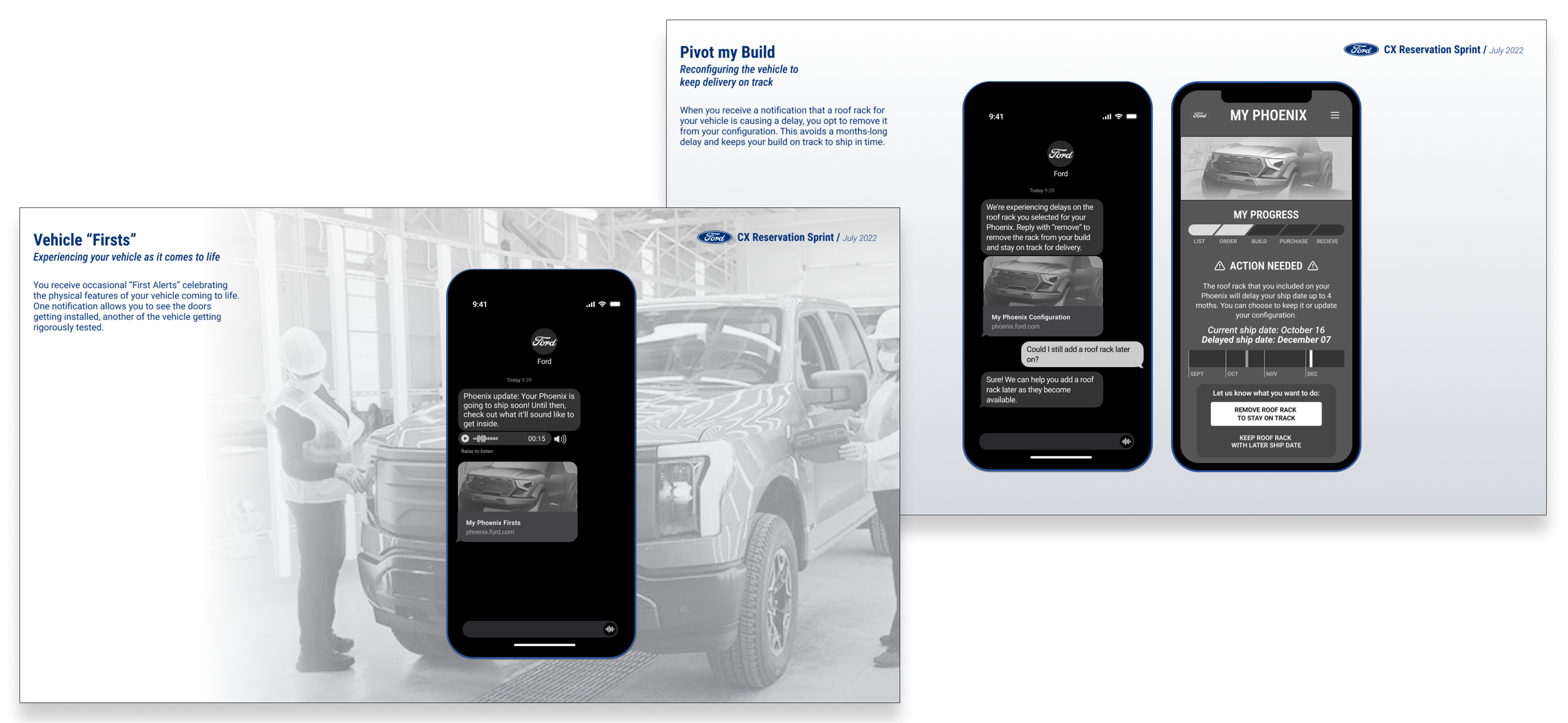
Detailed views of several slides in the final user-tested prototype.
Takeaways
Future-facing experience work doesn't always ship as designed, especially when it asks an organization to rethink long-standing processes and partner relationships. This project taught me to map business and operational constraints, like the dealership model, as carefully as user needs, and to bring those stakeholders into the work early. A validated vision creates the most value when the organization is ready to act on it, and helping build that readiness is part of the design work.